Short answer: DTU databases can't use reserved capacity, savings plans or Azure Hybrid Benefit. If part of your Azure SQL estate runs on DTU, moving it to vCore is the gate on every commitment discount available to you. The switch isn’t a migration. It’s a service tier change on the same server, so no data moves, connection strings stay the same and application code doesn’t change.
With Azure SQL reservations losing exchange rights on February 1, 2027 (here's what's changing and what to do now), every commitment you buy needs to be the right one the first time. That starts with knowing which of your databases can carry a commitment at all.
I kept thinking “we have heard this cost visibility, cloud tagging and attribution story one too many times.” For me, the game changing moment was when Aran began talking about reducing risk, proactive planning, and creating a secondary marketplace.
This is some text inside of a div block.
What are the Azure SQL Database purchasing models?
Azure SQL Database has two purchasing models, DTU and vCore, and vCore splits into provisioned and serverless. In practice, that's three ways of being billed.
DTU (Database Transaction Unit) bundles CPU, memory, reads and writes into one blended unit, sold in fixed tiers (Basic, Standard, Premium). Storage and point-in-time restore backups are included. The bill is predictable, but you can't see what you're actually using.
vCore provisioned sells virtual cores and service tier (General Purpose, Business Critical, Hyperscale) separately from storage. You pay hourly for allocated capacity, used or not. Storage and backups are separate line items.
vCore serverless scales compute between a minimum and maximum you set, billed per second. It can auto-pause when idle, which drops compute cost to zero while storage charges continue.
Microsoft recommends vCore for new deployments and documents how to switch existing DTU databases.
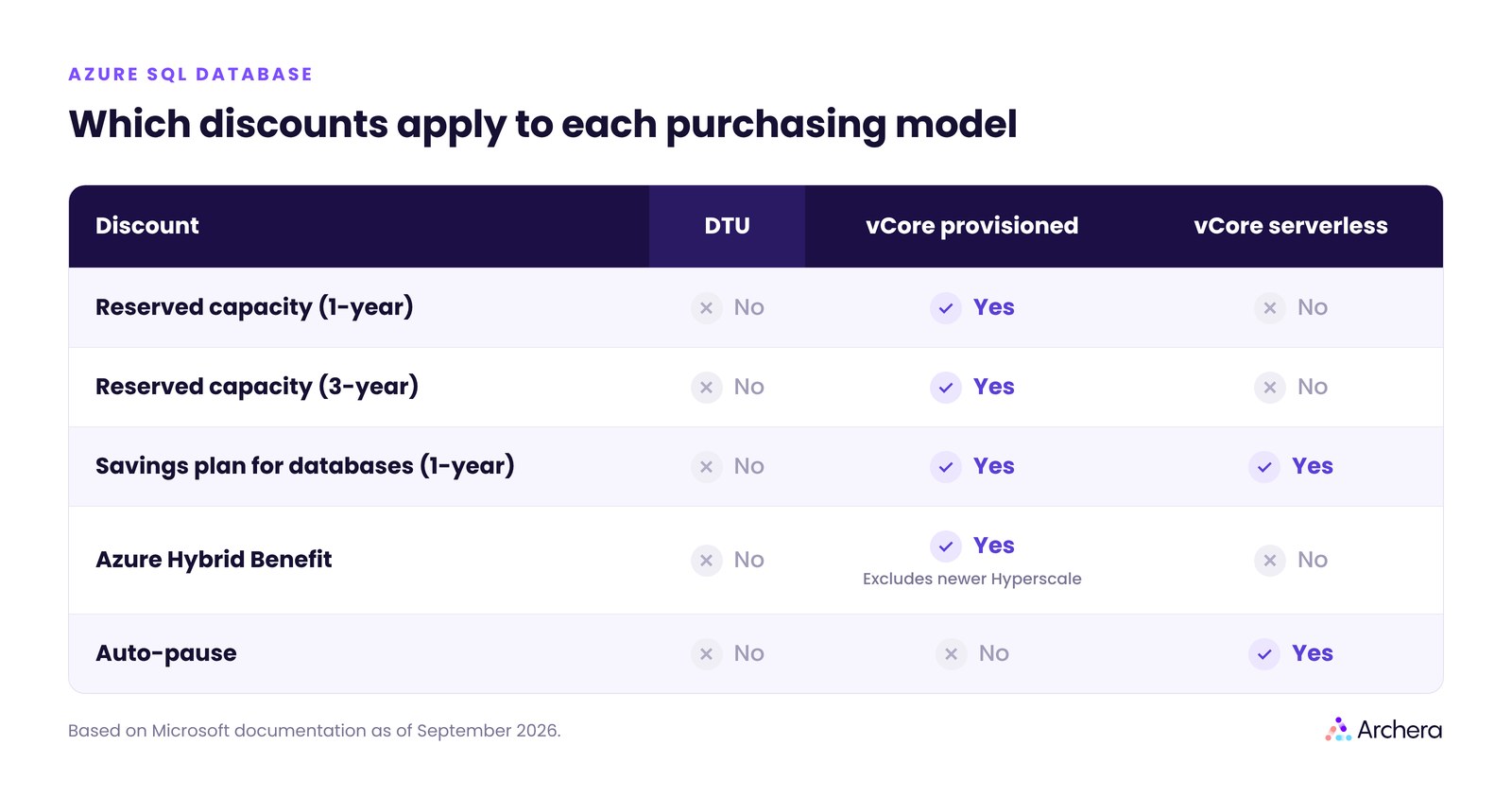
Which discounts apply to which model?
This table sets your discount ceiling.
Three things follow from it:
DTU has no commitment lever at all. The only options are right-sizing and dropping a tier. If you hold meaningful DTU spend, moving to vCore is a prerequisite for any commitment discount, not a modernization nice-to-have.
vCore provisioned has the deepest ceiling, because discounts stack. Reserved capacity and Azure Hybrid Benefit apply at the same time. Microsoft's "up to 80%" figure for Azure SQL comes from a specific Business Critical scenario combining both, not from a reservation alone.
vCore serverless got its first commitment discount in March 2026, when savings plan for databases launched. Reserved capacity has never applied to serverless.
Is switching from DTU to vCore worth it?
Usually yes, and for two separate reasons that most cost analyses collapse into one.
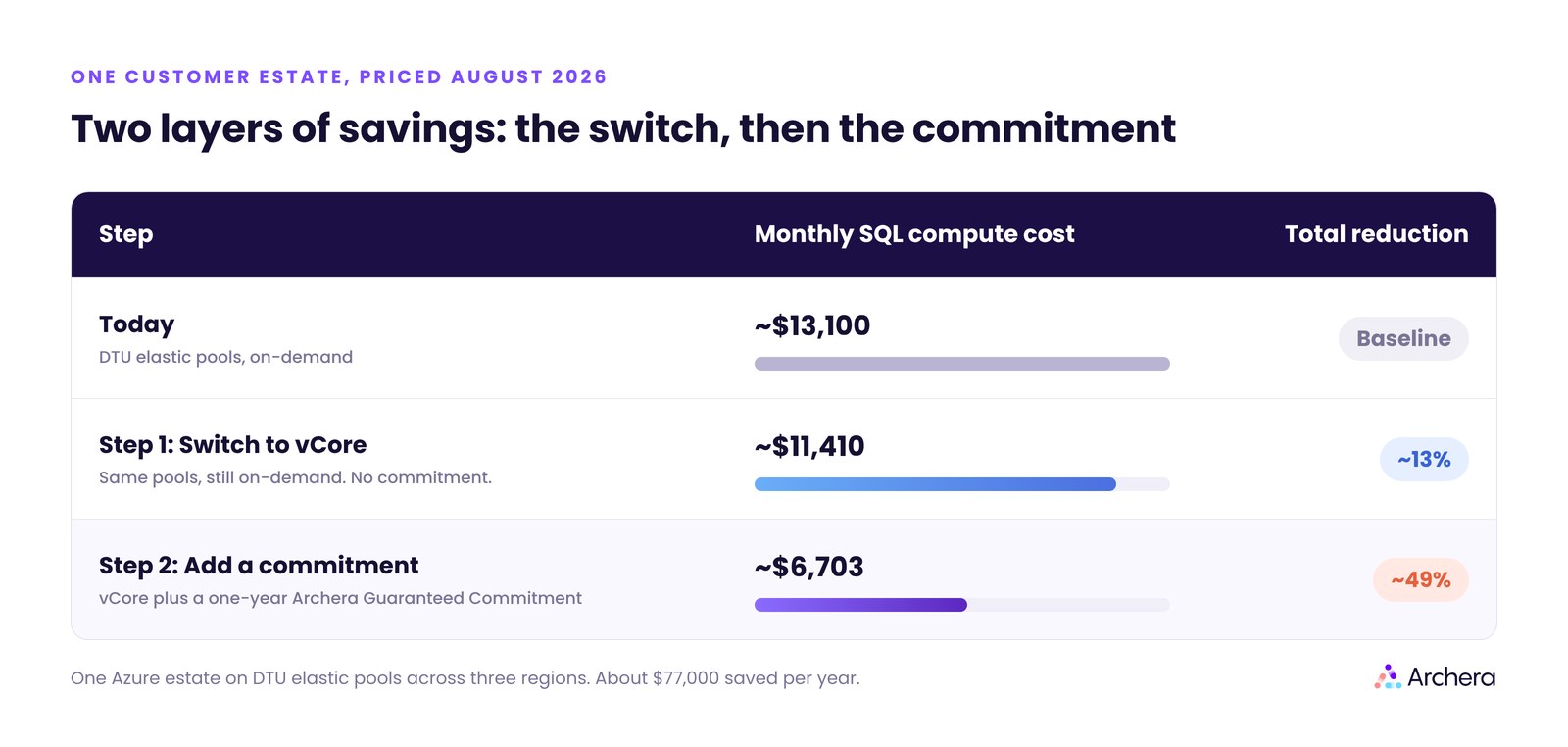
Most business cases assume the switch itself is roughly cost-neutral and all the savings come from the reservation you buy afterward. That's often wrong. vCore on-demand pricing can be cheaper than DTU for the same capacity, before any commitment. So the switch gives you two layers of savings, not one.
Here's a real example: an Azure estate running all of its SQL Database footprint on DTU elastic pools across three regions, priced in August 2026.
About 1,700 a month came from the switch alone with no commitment.The other~4,700 a month came from the commitment. Together, that's about $77,000 a year on a $157,000 annual SQL compute bill.
That first layer is the part nobody models. DTU tiers bundle compute and storage at fixed price points that are often poor value at mid-range pool sizes, while vCore lets you buy the capacity you actually need. Right-sizing during the switch adds to it.
How big does a pool need to be for the switch to pay off?
Roughly 180 to 200 DTUs per elastic pool.
vCore elastic pools have a two-vCore minimum. Below a certain size, that minimum is more capacity than the pool needs, so moving it makes it more expensive. In the estate above, 33 of 58 pools cleared the bar at about 183 DTUs and up. The other 25 pools and single databases were priced and deliberately left on DTU, because they'd cost more on vCore.
Those small pools aren't a lost cause. They're a consolidation question. Several small pools merged into one right-sized vCore pool can clear the floor together and become eligible for a commitment as a group.
The practical takeaway: price the switch pool by pool, not across the estate. An estate-wide average will tell you it's worth it while hiding a tail of pools where it loses money.
How many vCores replace a given number of DTUs?
Microsoft's starting point is about 100 DTUs per vCore for Basic and Standard (mapping to General Purpose) and about 125 DTUs per vCore for Premium (mapping to Business Critical).
Treat that as a hypothesis, not an answer. A DTU blends CPU, memory, reads and writes, so a straight conversion carries over whatever imbalance the old tier was hiding. Size each vCore target from the pool's actual CPU, IO and memory use. A reservation bought on a badly converted pool locks that error in for the full term, and after February 1, 2027 you can't exchange your way out of it.
What does switching actually involve?
A change of purchasing model on the same logical server. It isn't a data migration.
Each pool keeps its name, endpoint and connection string. Nothing is copied, no new server is stood up, and no application code changes. Microsoft treats it as a service tier change, the same operation used to scale a pool up or down. You can run it from the Azure portal, PowerShell, the Azure CLI or a single ALTER DATABASE ... MODIFY (EDITION=...) statement. Standard tier pools map to General Purpose Gen5.
The one real impact: open connections drop for a few seconds at the end of the switchover. Applications with standard SQL retry logic reconnect on their own. Run it in a normal maintenance window and it's a brief reconnect, not an outage.
That matters for the business case, because the objection you'll hear is that migration is a project. It's closer to a resize.
Where this fits before February 1, 2027
The order matters: switch, confirm the new sizing, then commit.
Find your DTU spend. Split the estate by purchasing model before you rank by cost.
Price each pool. Move the ones above the threshold, and look for consolidation among the rest.
Let the new sizing settle. Watch actual vCore usage before locking in a term.
Then commit. Choosing the right instrument, and sizing it, is its own decision. We walk through it in [INTERNAL LINK: Blog 3].
The catch is timing. An estate that’s mid-switch is exactly when you don't know your final footprint, and from February 1 a native Azure SQL reservation bought on a guess can't be exchanged.
How Archera helps while you switch to vCore
Archera lets you take the commitment discount without waiting for the estate to settle, and without betting a full term on numbers that are still settling.
30-day Guaranteed Commitments buy native Azure Reservations directly into your tenant, with an obligation measured in weeks rather than years. Your relationship with Microsoft and your reseller doesn't change.
One-year Guaranteed Commitments cover Azure Reservations and savings plans, at deeper discounts than the equivalent native one-year commitments. As pools prove stable over 30 to 60 days, moving them from 30-day to one-year improves the rate.
If capacity goes unused, Archera covers the loss under its insurance-backed guarantee. That protection is a contract between Archera and you, so it doesn't depend on Microsoft's exchange rules.
See where your Azure SQL estate stands. Archera's platform is free and shows your coverage, utilization and missed savings across Azure, AWS, and Google Cloud.
No. It's a service tier change on the same logical server. Pools keep their name, endpoint and connection string. Open connections drop for a few seconds, and apps with standard retry logic reconnect automatically.
Can I buy reserved capacity or a savings plan for a DTU database?
No. DTU supports neither reserved capacity, savings plan for databases nor Azure Hybrid Benefit. You need to move to vCore first.
Does moving from DTU to vCore save money before I buy a reservation?
Often, yes. In one August 2026 estate, moving DTU elastic pools to vCore cut monthly SQL compute cost by about 13% before any commitment, from about $13,100 to about $11,410. A commitment then took the total to about 49%.
What's the minimum elastic pool size for the switch to make sense?
Roughly 180 to 200 DTUs. vCore elastic pools have a two-vCore minimum, so smaller pools cost more on vCore. Price each pool individually and treat small ones as consolidation candidates.
How many DTUs equal one vCore?
About 100 DTUs per vCore for Basic and Standard (General Purpose), and about 125 for Premium (Business Critical). Confirm against each pool's actual CPU, IO and memory use before committing.
Can I buy reserved capacity for serverless?
No. Reserved capacity applies only to vCore provisioned. Serverless is eligible for savings plan for databases, launched March 18, 2026.
Pricing, discount ranges and policy details reflect published Microsoft documentation as of September 2026. Discounts vary by region, tier, SKU and agreement. Model your own estate before committing.
Stay up to date! Subscribe to the Archera newsletter to get updates on cloud offerings and our platform.

 AWS
 Azure
 Google Cloud