.jpg)
Cloud Costs
Every cloud cost tool promises savings. Fewer than half of them actually help you capture them. Here's an honest look at what's out there, and what separates the tools that change the game from the ones that just add another dashboard.
I kept thinking “we have heard this cost visibility, cloud tagging and attribution story one too many times.” For me, the game changing moment was when Aran began talking about reducing risk, proactive planning, and creating a secondary marketplace.
TL;DR:
The cloud cost management software market has never been more crowded, or more confusing. Every vendor promises savings. Every platform claims to be the easiest to use. And yet cloud waste continues to be one of the largest line items on technology budgets across industries.
This guide cuts through the noise. We've compared the leading tools across the dimensions that actually matter for FinOps and engineering teams: commitment management depth, pricing model transparency, flexibility, and what's truly differentiated versus what's table stakes.
Before diving into individual tools, it helps to understand the categories of functionality that matter:
Best for: Commitment management, insured flexibility, and PPA risk management
Archera is the only platform that combines a free commitment lifecycle management platform with first-of-a-kind insurance-backed products. Where most tools stop at visibility and recommendations, Archera actually changes the risk profile of your cloud commitments.
Key differentiators:
See Archera in action. Book a demo →
Best for: Basic visibility into AWS spend
AWS Cost Explorer is the built-in reporting and recommendations tool included with every AWS account. It's a solid starting point for teams just beginning their FinOps journey. You can see spending by service, region, and account, and get basic RI and Savings Plan recommendations.
The limitations become apparent quickly for mature teams: recommendations are conservative, there's no automation, no cross-account commitment optimization, and no flexibility products. It's free, but you'll outgrow it fast.
Best for: Enterprise multi-account reporting
CloudHealth is one of the oldest players in the space and has deep enterprise reporting capabilities. It's widely used by large organizations that need to manage dozens of AWS and Azure accounts with complex tagging and allocation requirements.
On the commitment management side, CloudHealth provides recommendations but limited automation. The platform is robust but heavyweight; implementation timelines can be significant, and pricing is opaque.
Best for: FinOps reporting and showback
Cloudability (now part of IBM Apptio) is a strong choice for organizations focused on cost allocation, showback, and chargeback. It excels at the reporting layer and integrates well with enterprise ITFM tools.
Commitment purchasing and optimization is less of a focus. Teams looking for automated purchasing decisions will find Cloudability better positioned as a reporting layer than an execution layer for commitment purchasing.
Best for: Spot instance automation
Spot by NetApp focuses on a different angle of cloud cost optimization: running workloads on spot/preemptible instances at a significant discount. For stateless, interruption-tolerant workloads, Spot can drive meaningful savings.
The tradeoff is applicability, not every workload is a candidate. And Spot's commitment management capabilities are secondary to its core spot automation product.
Best for: Automated Savings Plan purchasing
ProsperOps takes a narrow but well-executed approach: automating the continuous purchase and management of Compute Savings Plans for AWS. The platform is low-touch and often delivers results quickly for teams without dedicated FinOps resources.
The limitation is breadth: ProsperOps focuses primarily on Compute Savings Plans, so teams with complex commitment portfolios (EC2 RIs, RDS RIs, Azure reservations) will find coverage gaps. Pricing is percentage-of-savings, which can become expensive at scale.
Best for: Automated commitment optimization
Zesty uses ML-based automation to continuously right-size and adjust commitment coverage. The platform is highly automated and low-maintenance, which is appealing for lean teams.
Like ProsperOps, Zesty's pricing is percentage-of-savings, which creates alignment incentives but can also mean significant fees as savings scale. The platform also lacks flexibility products for teams that need insurance-backed risk management.
Best for: Resource rightsizing
Densify focuses on the compute rightsizing problem; identifying over-provisioned instances and recommending optimal instance types and sizes. This is a meaningful source of savings for organizations with legacy instance selections.
Densify is complementary to commitment management rather than a direct substitute. Teams typically use it alongside a commitment-focused tool.
Best for: Hybrid and multi-cloud visibility
Flexera One is an enterprise-grade platform with broad coverage across cloud, SaaS, and on-premises infrastructure. For organizations with complex hybrid environments, it offers a unified view that others can't match.
The breadth comes at the cost of depth. Cloud-specific commitment optimization is not Flexera's core strength, and the platform is typically positioned for large enterprise IT asset management use cases.
Best for: Kubernetes cost allocation
Kubecost is purpose-built for Kubernetes environments and provides granular cost visibility at the namespace, pod, and deployment level. For teams running significant Kubernetes workloads, it fills a real gap that generalist tools often miss.
It's best used as a complement to a commitment management platform rather than a standalone cloud cost solution.
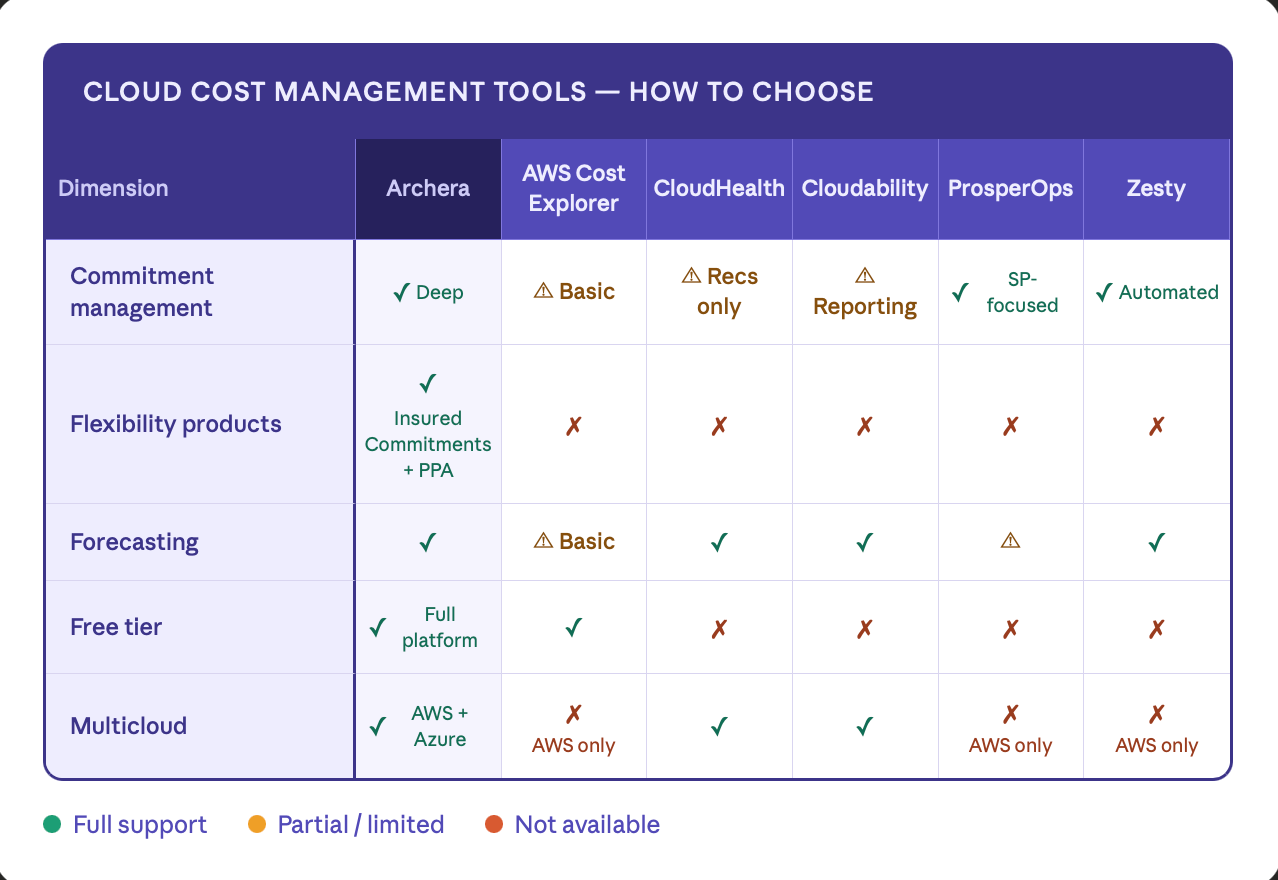
Most cloud cost management tools solve the visibility problem. Far fewer solve the execution problem and almost none address the risk problem.
That's the gap Archera was built to close. With a free commitment management platform, insurance-backed flexible commitments, and PPA shortfall protection, Archera gives teams the tools to not just see their savings opportunity, but actually capture it safely.
See why thousands of organizations trust Archera to manage their cloud commitments. Schedule a demo →


.svg)
.svg)
.svg)
.svg)
.svg)