“The flexibility allowed us to realize savings on resources demonstrated that are not in steady state.”
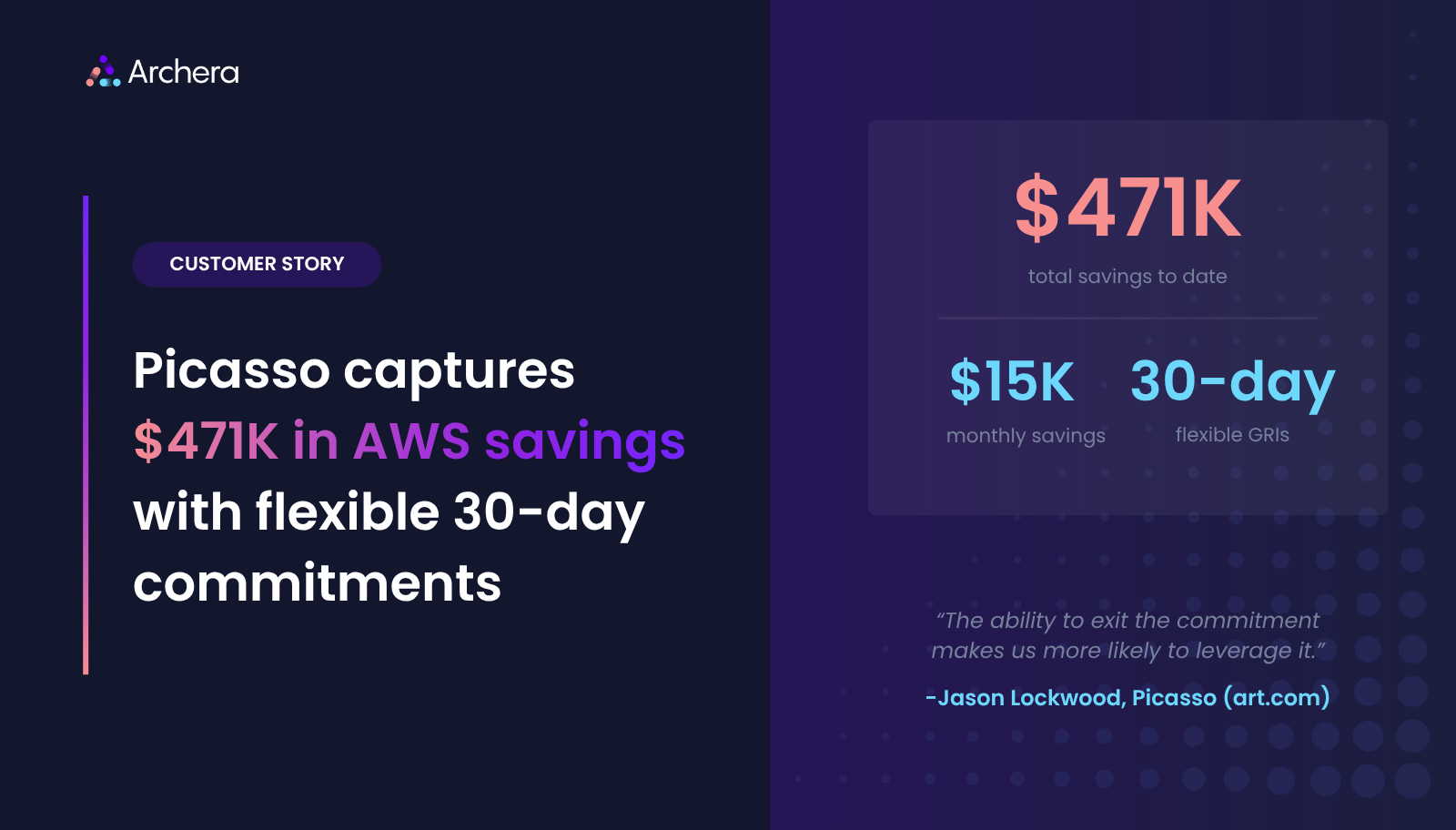
Picasso (Art.com) sells customizable framed artwork, delivering personalized pieces to customers at scale. As part of its modernization journey, the company completed a multi-year migration from on-prem VMware infrastructure to AWS, containerizing applications and moving the majority of workloads to Kubernetes.
Today, Picasso runs:
But like many growing companies navigating acquisitions, divestitures, and organizational change — including joining Trends International — Picasso’s cloud footprint hasn’t been static.
With fluctuating usage patterns, evolving architecture, and shifting team size, long-term cloud commitments created risk.
They needed savings without lock-in.
When Picasso joined Trends International and inherited the existing Archera relationship, the team quickly understood why it had been kept: the value was clear from day one.
“The flexible reservation and not being stuck in multi-year, misaligned reservations stood out.”
Traditional 1- and 3-year AWS Reserved Instances and Savings Plans can deliver demonstrated discounts, but only if usage remains predictable. Picasso’s workloads were anything but steady state.
Without flexibility, the team risked:
Archera’s 30-day Guaranteed Reserved Instances (GRIs) changed the equation.
Instead of committing to multi-year contracts, Picasso could secure savings equivalent to longer-term discounts — but with the ability to exit after 30 days.
“The ability to exit the commitment makes us more likely to leverage it.”
That short-term flexibility encouraged experimentation — enabling the team to commit transient Kubernetes workloads that would otherwise have stayed on-demand.
In parallel, Archera’s unified portal became Picasso’s first stop for cloud financial decisions.
“Consolidating all cost and utilization data into one place allowed us to compare native AWS costs and GRIs and decide whether sunk costs should remain in place.”
Before diving into AWS Cost Explorer, the team now uses Archera for a big-picture view of:
To date, Picasso has achieved:
Much of that value came from identifying inefficiencies that native AWS tooling made harder to see.
“I wish I’d known how many dead and unused resources were running.”
Archera's visibility made it far easier to identify waste and underutilized resources, surfacing opportunities to clean up and rebalance commitments.
The 30-day GRI model also enabled Picasso to shift workloads between purchase models based on observed utilization, something that would have been financially risky under traditional multi-year reservations.
Beyond pure cost reduction, Archera changed how the team approaches cloud commitments.
“The ability to exit the commitment makes us more likely to leverage it.”
With lower downside risk, the team is more willing to apply discounts to dynamic workloads instead of defaulting to on-demand.
The consolidated homepage view helps guide decisions about:
Archera serves as a shared reference point for engineering and finance, providing clarity on how commitments are performing and when they expire.
“It’s been mostly a win with our flexibility options leveraging the 30-day GRIs.”
Picasso’s next FinOps milestone isn’t vendor-dependent — it's organizational.
“The next step is reaching a predictable growth or steady state so we can adopt longer-term GRIs to increase savings.”
As workloads stabilize, Picasso plans to layer in longer-term commitments for even deeper savings. The key difference now is that those decisions will be informed by clear utilization data and flexible modeling.
Jason Lockwood also noted areas where Archera could go even further:
Archera has acknowledged this feedback and is incorporating modeling discussions into its upcoming Customer Advisory Board.

For teams navigating cloud migrations, acquisitions, or fluctuating usage, Picasso’s experience offers a clear takeaway:
Flexibility first. Optimization second.
Short-term commitments with multi-year-equivalent savings let organizations optimize confidently — without the risk of being locked into the wrong resources.
Company: Picasso (Art.com)Industry: Customizable artwork & ecommercePrimary workloads: Kubernetes, EC2 Savings Plans, OpenSearchTotal savings to date: ~$471,000Ongoing monthly savings: ~$15,000Key benefit: Multi-year-equivalent savings with 30-day exit flexibility








Learn how Archera customers are succeeding in the cloud:
Discover their stories


.svg)
.svg)
.svg)
.svg)
.svg)