.png)
Cloud Costs
I kept thinking “we have heard this cost visibility, cloud tagging and attribution story one too many times.” For me, the game changing moment was when Aran began talking about reducing risk, proactive planning, and creating a secondary marketplace.
Most organizations have no idea if their cloud cost optimization efforts actually make money.
They celebrate a 20% reduction in EC2 spending. They high-five over rightsizing recommendations. They present dashboards showing commitment coverage trending upward. But ask them if these initiatives generated positive ROI after accounting for engineering time, tooling costs, and opportunity cost? Crickets.
This isn't just a reporting gap—it's strategic blindness that turns cost optimization from a profit center into expensive theater.
_.

-
The FinOps Foundation defines Cloud Unit Economics as "a system of profit maximization based on objective measurements of how well your organization is performing against not only its FinOps goals, but as a business overall."
Breaking that down: unit economics measures marginal cost (what you spend per unit) and marginal revenue (what you earn per unit) to determine where you break even and start generating profit.
Your "unit" might be a customer, transaction, API call, or active user—whatever makes sense for your business.
The business impact: Unit economics bridges cloud spending to actual business value. Instead of knowing you spent $2M on AWS last quarter, you know your cloud cost per customer is $12, revenue per customer is $45, and contribution margin is $33. When you optimize and drop cost to $10, you can quantify the impact: margin improved 18% per customer.
Real example: A SaaS company with 100K customers and $10M annual cloud spend has a unit cost of $100/customer/year. Save 15% ($1.5M) on your production infrastructure, and cost per customer drops to $85. With $500 annual revenue per customer, gross margin improves from 80% to 83%—a meaningful lift that compounds as you scale.
That's the power: translating technical optimization into business language that CFOs and boards actually care about. Teams often achieve this by combining cloud cost optimization platforms such as Archera with unit economics capabilities available through a broad partner ecosystem.
-

-
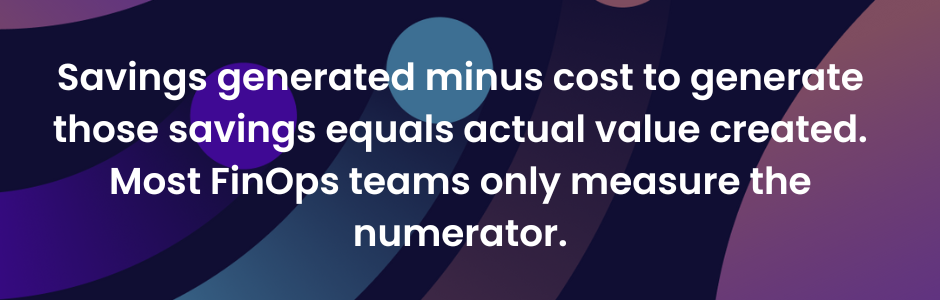
But here's what most teams miss: savings generated minus cost to generate those savings equals actual value created. Most teams only measure the numerator.
Let's get specific. Your team spends three months analyzing workload patterns, building automation, and implementing a right-sizing strategy that saves $500K annually. Sounds great, right?
Now add it up: Engineering time: 2 senior engineers × 3 months = ~$100K
Ongoing management: 20% of one engineer = $40K/year
Tooling and analytics: $50K/year
Opportunity cost: What didn't get built?
That $500K in savings costs $190K+ annually to maintain, before accounting for what your engineering team didn't ship. Your actual ROI might be 2.6x—decent, but nowhere near the "20% savings" headline in the board deck.
Most organizations never run this calculation. They optimize without knowing if optimization is worth it.
-

-
Understanding rate optimization versus usage optimization becomes financially critical here.
Usage optimization—rightsizing instances, eliminating waste, architecting for efficiency—requires continuous engineering effort. Every workload change potentially invalidates previous work. Your unit economics include ongoing costs that compound over time.
Rate optimization is different math. You're negotiating better prices for compute you're already using. Done right, it generates ongoing returns without proportional ongoing costs.
Consider a $10M annual cloud spend:
Usage optimization: 15% savings ($1.5M), 2 FTE + tooling ($250K+/year). Net: ~$1.25M/year, ongoing effort.
Rate optimization: 15% savings ($1.5M), minimal ongoing management. Net: ~$1.4M+/year, largely automated.
The unit economics clearly favor rate optimization—if you can execute without traditional commitment risks.
Here's where most rate optimization strategies implode: the risk costs that never make it into ROI calculations.
Traditional Reserved Instances or Savings Plans lock you into commitments based on predictions of future usage. When you're wrong—and you will be—you face real financial consequences:
Undercommitment costs: Money left on the table. Easy to calculate in hindsight, impossible to recover.
Overcommitment costs: Paying for unused commitments. This shows up in your bill, but rarely gets measured against "savings."
Inflexibility costs: Can't pursue better architecture or respond to market changes because you're locked in. How do you value strategic paralysis?
Most critically: Fear-induced opportunity cost. Teams become so afraid of mistakes that they massively undercommit, leaving 30-40% of potential savings unrealized. Rational behavior given the risks—but millions left on the table.
Your unit economics need to account for all of this. When they do, traditional strategies often show mediocre returns despite impressive headlines.
This is where Archera's Insured Commitments fundamentally change the unit economics calculation.
Instead of choosing between commitment risk and commitment savings, you get three-year savings rates with 30-day flexibility. The math becomes:
Gross savings: Same as traditional 3-year commitments (30-40%+ off on-demand)
Risk costs: Near zero (30-day adjustment windows eliminate overcommitment risk)
Management overhead: Minimal (automated optimization handles complexity)
Strategic flexibility: Preserved (never locked in beyond 30 days)
Yes, there's a risk premium to Archera for insuring your commitments. But that premium is typically 5-30% of gross savings—meaning you capture 70-95% of maximum savings while eliminating nearly all commitment risk and management overhead.
The unit economics are compelling: pay someone else to absorb your commitment risk and handle optimization complexity, while you keep most savings and regain strategic flexibility. For most organizations, this trade massively improves ROI compared to DIY commitment management.
_

_
Before your next cost optimization initiative, run the actual numbers:
1. Gross savings potential: Dollar value if everything works perfectly
2. Implementation costs: Fully-loaded engineering time to build it
3. Ongoing costs: Annual cost to maintain and manage it
4. Risk costs: Expected value of mistakes and suboptimal decisions
5. Opportunity costs: What isn't getting built while you're doing this
Divide actual net benefit by total cost. That's your real ROI.
If the number isn't at least 3-5x, you're optimizing the wrong things or using the wrong approach. If you're not measuring it at all, you're flying blind.
Unit economics turn cost optimization from a cost center that reduces spending into a profit center that generates value. There's a massive difference.
Know your numbers. Measure actual ROI, not just gross savings. Account for engineering time, tooling costs, risk, and opportunity cost. Choose optimization strategies that improve unit economics, not just headline percentages.
Because the question isn't "how much did we save?"—it's "how much value did we actually create?"
Most teams can't answer that question. Can you?


.svg)
.svg)
.svg)
.svg)
.svg)